Women at the end of the world: female roles in the Ragnarök Myth
Written by Josefine Humble
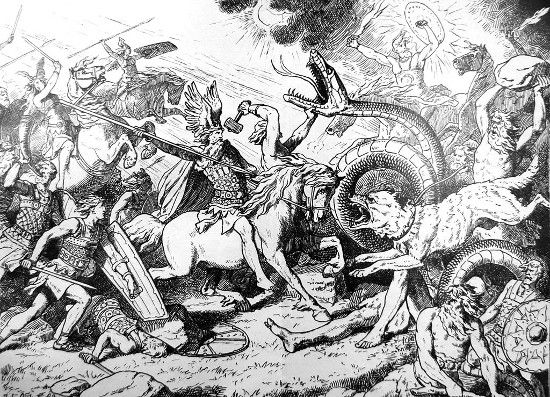
Ragnarök, the infamous apocalyptic cataclysm that ends the current world in Norse mythology, is usually imagined as a battlefield of men and monsters, a stage dominated by Odin, Thor, Loki, Fenrir, and Surtr. But beneath the crashing waves and burning skies lies a more subtle narrative: women actually play a crucial and often overlooked role in the mythology of the world’s end. Through prophecy and magic they shape Ragnarök much before the final wolves swallow the sun and moon.
The role women play in Ragnarök begins with prophecy. In Norse mythology, prophecy is a force that shapes events; the voices that articulate Ragnarök before it happens most clearly are female voices.
The most iconic is the völva (the seeress) of Völuspá, the opening poem of the Poetic Edda. She is summoned by Odin himself, who acknowledges the depth of her knowledge despite being the King of the Gods. The völva recounts through her visions the world’s beginning, the inevitable fall of the gods, and the rebirth that follows.
Crucially, the völva’s prophecy shapes Ragnarök and gives it inevitability. Without her voice, the myth would be chaotic destruction; with her, it becomes part of a cosmic cycle. The völva is one of the most powerful literary figures in world mythology, she is a woman who knows more than the Gods and speaks truth to them without fear of their power and authority.
Another essential female presence in Ragnarök is Freyja; she is the goddess responsible for preparing many of the warriors who will ultimately fight in the world’s final conflict. Freyja’s warriors are crucial to Ragnarök just as Odin’s einherjar are. Freyja plays a part in the machinery of fate, influencing the balance of power at the end of days.
That brings us to the giantesses, whose connections to Ragnarök are troubling for the gods. Many of the monsters who bring about the downfall of the divine world (Fenrir, Jörmungandr, and Hel) are the children of Angrboða, a fearsome giantess of the Ironwood. She is a mother of chaos because her offspring represent the consequences of the Gods’ own actions and greatest fears. Angrboða’s daughter, Hel, the ruler of the underworld, is very important. In Ragnarök, Hel’s realm opens, and the dead march behind Loki in a ship made of nails. Hel is the Queen of the dishonoured dead, and she controls a force that the Gods cannot touch. Her authority rivals Odin’s, as he governs the dead he chooses while she governs all the rest.
Furthermore, female figures also embody the cosmic forces that collapse during Ragnarök. The sun, Sól, is a goddess who is devoured by a wolf; but her death symbolises the scope of the catastrophe rather than helplessness. In Norse cosmology, the heavens themselves are feminine, and their destruction signals the end of natural cycles.
Moreover, women are even involved in the moral structure of Ragnarök: the breaking of oaths, the crumbling of kinship bonds, and the rise of treachery are often illustrated in the sagas through female warning. In mythic time, these dynamics foreshadow the final collapse of Ragnarök. The prophetesses and wise women are able to sense the unraveling long before the warriors eventually pick up their swords in the final battle.
Ultimately, what makes women’s roles in Ragnarök so compelling is that they do not often appear on the front lines of battle. Instead, their influence is symbolic and prophetic. Women create the conditions for Ragnarök, foretell its coming, and survive it in both memory and lineage. Additionally, the myth ends not simply with destruction but with renewal, and in that renewal we once again find female figures: a new sun, Sól’s daughter, rises into the sky, ensuring continuity.
Women are the architecture of the myth of Ragnarök. Their presence transforms Ragnarök from an ending into a cycle, which is a cosmic rhythm of continuity that mirrors the Norse understanding of time. Through doing so, women make the world’s end meaningful.

Comments