Yggdrasil: An Overview of the Norse Cosmos - Nine Worlds on a World Tree
- josefinehumble
- Jun 5
- 4 min read
Written By Josefine Humble
Norse mythology presents one of the most imaginative cosmological systems in world literature: a universe suspended within a vast, sacred ash tree called Yggdrasil, where gods, giants, humans, spirits, and monsters inhabit interconnected realms. Norse cosmology is fluid and layered, reflecting the worldview of people who navigated harsh landscapes and unpredictable seas.
The pillar that stands at the centre of everything is Yggdrasil, the world tree. It is described in the Poetic Edda, particularly in Völuspá and Grímnismál; Yggdrasil binds the cosmos together through its towering branches and deep roots. It is the backbone of existence, with its trunk touching the human world, its roots extending into the worlds of gods and giants, and its branches reaching into the heavens. All aspects of life occur on this tree, and cosmic energy flows from it. Yggdrasil plays the role of both a structure and a metaphor: it is stability in a world destined for collapse at Ragnarök.
The universe that is supported by Yggdrasil’s structure is said to consist of nine worlds. However, the medieval texts never list them all explicitly, so scholars reconstruct them using references scattered across the Eddas.
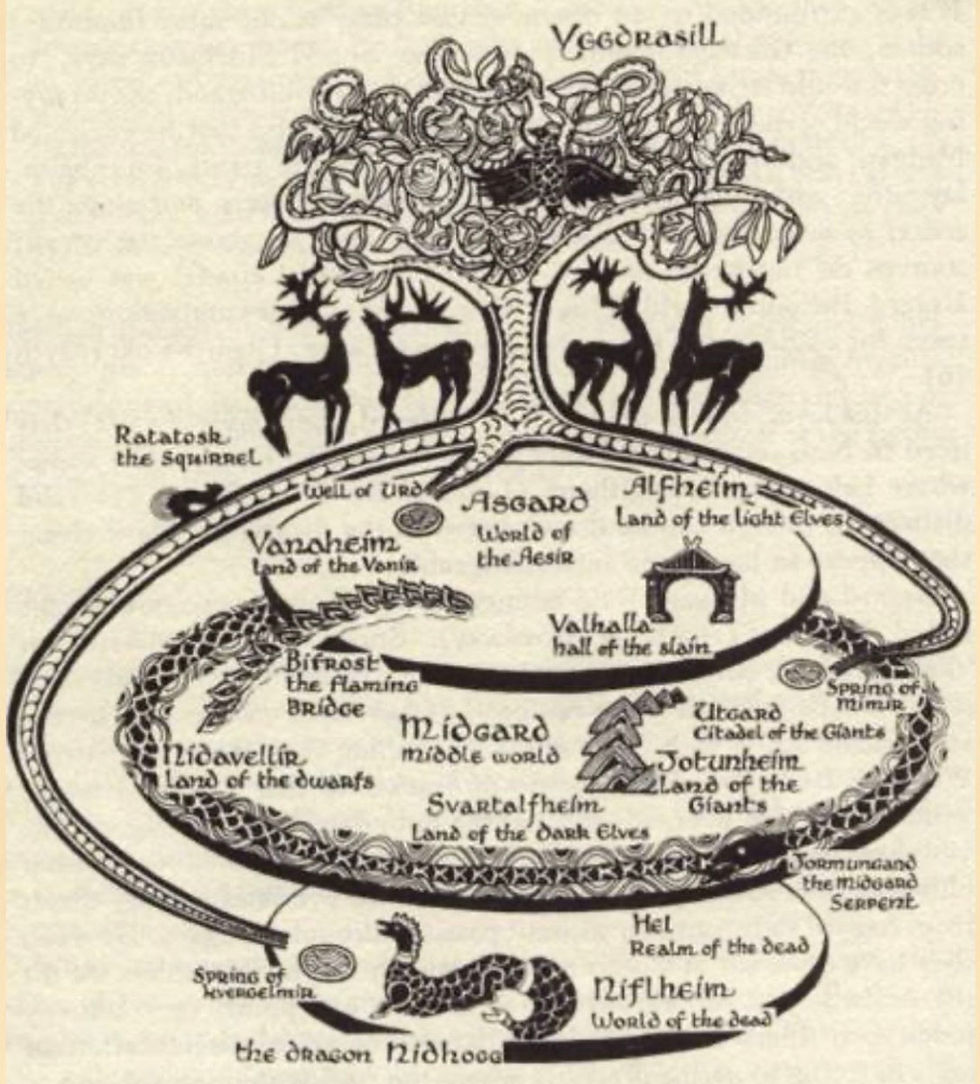
Kevin Crossley-Holland's The Norse Myths (1988)
The most important of the worlds is Ásgarðr, the world of the Æsir Gods, who are commonly associated with war, power, and leadership, such as Odin, Thor, Frigg, and the central pantheon. Within Asgard is Valhalla, the hall of the slain, where the chosen warriors feast and train for the final battle of Ragnarök. Asgard is both a celestial palace and a political centre, it is surrounded by walls and is connected to the human world by the rainbow bridge Bifröst.
Connected to Asgard yet very different is Vanaheimr, which is the world of the Vanir Gods, who are commonly associated with fertility, prosperity, and natural cycles. The Vanir once went to war with the Æsir. It was a conflict that reflected the tension between the Sky Gods and the Earth Gods that we can see in many myths. Eventually, they made a truce and exchanged hostages (Freyja, Freyr, and Njörðr); this symbolised the integration of different cultural traditions within Norse society.
Moving on, below Asgard lies Miðgarðr, the world of humans. The name means “Middle Enclosure”, this reflects how Norse society regarded human life: as protected yet threatened by forces beyond human control. Midgard is encircled by an ocean so vast and wide that it contains Jörmungandr, the World Serpent, whose body forms a ring around the human world. This boundary between civilisation (the enclosure) and chaos (the outer waters) mirrors the common Viking understanding of community and danger.
Next, is Jötunheimr, the land of the giants, which lies beyond Midgard. Giants in Norse mythology are not just brutish monsters but they are primordial beings who embody nature’s raw and untamed power. Many gods (including Odin) are descended from giants, and there are a surprising number of mythic romances that occur between gods and giantesses. Jötunheim is both a threat and a source of knowledge, which reflects the uncertain boundary between these two things.
Additionally, further down on the cosmic structure we have Niflheim, a world of cold and ancient darkness. One of Yggdrasil’s (the tree’s) roots extends here, touching the well Hvergelmir, from which many rivers flow. Niflheim represents the primordial void that existed before creation, which acts as a reminder that the universe emerged from a meeting of fire and ice.
Its fiery counterpart is Múspell, which is a glowing and burning world ruled by the fire giant Surtr. When Surtr rides at Ragnarök, it is from Muspell, and he wields his flaming sword and burns the world tree’s branches. Muspell symbolises destructive energy; however it is not an evil force, but rather the necessary force that ends cycles so new ones can begin.
Moreover, lower down and also beneath Midgard lies Hel, the realm of the dead who did not die gloriously in battle. It is ruled by the goddess Hel, the daughter of Loki; this world is bleak but not necessarily torturous. It reflects the Norse understanding of death as a continuation of life’s conditions, most people went where ordinary souls go. The existence of Hel alongside both Valhalla and Freyja’s Fólkvangr demonstrates the diversity of Norse afterlives.
Another significant realm is Svartálfaheimr, which is the world of the dwarfs. These dwarfs forged treasures like Mjölnir (Thor’s hammer) and Gungnir (Odin’s spear). Their underground world mirrors Scandinavian mining culture and the idea that divine power often emerges from hidden or dangerous places.
Lastly, the remaining world is Álfheimr, the land of the light elves. The light elves are luminous beings who are associated with fertility and beauty. Freyr (Freyja’s brother) rules over them, which creates another link between the Vanir Gods to life cycles and growth.
These nine worlds are not isolated, they are connected by pathways, rivers, roots, and mythic bridges. Movement between them is common: it’s seen through Odin’s wanderings, Thor’s journeys to Jötunheim, and souls travelling to the afterlife from the human world. The Norse cosmos is constantly under threat: from serpents gnawing at roots, from giants testing boundaries, and from the eventual inevitability of Ragnarök.
Norse cosmology is so compelling as worlds are separated yet they continually interact with each other through different means.

Comments